Showing posts with label Rigpa. Show all posts

Thursday, July 21, 2011

The Way of the Lotsawa


Since my last post, which seems like an eon ago, much has happened. In the last blog post which was quite at the beginning of the Rigpa Shedra 2011, I wrote about my experience of a dharmic life studying and teaching in Nepal. The shedra concluded at the end of April. At that point four months of teaching Tibetan on three levels, studying Mipham Rinpoche’s commentary on the great treatise Abhisamayalamkara, and being part of the shedra staff was behind me. Leaving the little hillside village of Pharping, I flew to New York City to reunite with my woman and meet friends. The first evening I found myself having dinner with four close buddies from Rigpa, all of whom participated in the Three Year retreat and only one who was actually American. I really love this international life of meeting people I know wherever I travel and especially connecting with my Rigpa colleagues.

After a few days in Massachusetts I journeyed to Hamburg, Germany to attend my brother and sister–inlaw’s wedding celebration. Seeing my family and old friends charged my ‘family’ batteries which tend to run a bit low as I am rarely returning to my homeland these days. Less than 10 days later I went back to the US. I was able to continue studying Tibetan and finish off a translation I had begun but unfortunately not as much as I had planned. I became heavily involved in my hobby of photography as suddenly I had three exhibits to set up. After my first show at GoBerry in Northampton this past winter with the theme of ‘Tibetans in Exile’, I was given the opportunity to hang photos at Pleasant Street Tea Company in Gloucester. Additionally, I had two successive shows scheduled in Northampton taking place in July and August. The theme of these recent shows is titled ‘The Splendor of Asia’ (click to see all images) and contains photos from Nepal and India. This is of course a reason to celebrate. Despite the work involved and the time it takes away from my Tibetan affairs, I am still glad I can do these things as so many work aspects need to be considered and looked at. This means my organizational and communicative brain departments have become highly trained!

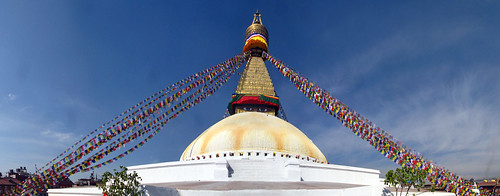
One of the photos from my exhibits: The Boudha Stupa, Kathmandu.

At the end of my trip to the US, Greta and I were able to attend the Wisdom of Awareness retreat at Garrison Institute in New York state. For five days, Sogyal Rinpoche and Tsoknyi Rinpoche gave a number of wonderful teachings. In addition American teachers Daniel and Tara Goleman and Sharon Salzberg gave talks to an eager and engaged audience. For the first time, I witnessed the coming together of traditional Buddhist teachings and western psychological-therapeutic knowledge and research. As I have a certain amount of experience in both fields, I was glad to see both forms of mind analysis collaborating and cooperating more and more. As Chögyam Trungpa Rinpoche had foreseen, “Buddhism will come to the West as a psychology”. Practising the Buddha’s teachings without a knowledge and awareness of the neurotic patterns present in so many western people can become what some call ‘spiritual bypassing’, i.e. not dealing with our fundamental emotions and mental complications. I had been asked to document the retreat with photos which I was happy to do. I feel having good photos of our lamas is something very important, for our personal present use and for posterity.

Sogyal Rinpoche during the Garrison Retreat


Soon again I found myself hopping onto planes which would bring me to the Indian business metropolis of Bangalore. Having arrived there in the middle of the night, a high standard bus (the only kind of bus I’m taking in India after my accident last year) dropped me off in Kushal Nagar after a five hour drive. A fifteen minutes rickshaw drive led me to my final destination, Namdroling Monastery or the Golden Temple, as the local Indians call it. I arrived later than planned, yet still in advance to help set up Rigpa’s second Tibetan Translator Training. Despite some previous correspondences with the monastery, a good amount of organizational work was still necessary. After a few days and in time for the training to begin we had arranged a class room, a khenpo to teach, and monk and nun lobpöns who would be our conversational partners. Now the second week is almost over and I am happy with the format and schedule of the programme.

Our Translation class with current khenpo Karma Tsering.


The Tashi Delek Restaurant Gang

Here at Namdroling, in the early mornings I am speaking to a lay Tibetan, a friend of ours, practicing my colloquial Tibetan. Later on a khenpo teaches the group on a text and we take turns attempting to interpret. The khenpo’s dialect pronounciations are different. For instance vowel sounds are different than how they are taught to be pronounced in books. But after all, not a single Tibetan speaks according to them anyway. After lunch I have another tutor session with a lobpön from Khenpo Jigme Phüntsok’s monastery of Larung Gar in Tibet. He and I are getting along very well but his accent is so strong making it a challenge. One of the exercises that we do is to go over the part of the text which was covered in the class, using a mix of colloquial and classical Tibetan to describe its content. The whole point is to concentrate on Dharma Tibetan. In the afternoon my last class is a grammar class for colloquial Tibetan after which I have time for my personal studies. Our small group, which currently consists of three students plus two teaching members, resides in two guesthouses, one which is in Namdroling, the other is close by. I make daily circumambulations of the massive monastery which takes twenty minutes but which incorporates my walk to the surrounding restaurants where I eat and practice my language skills with the locals.

Admiring the Hero.

Giving way to India's holy cows

Besides attending formal classes and engaging in personal studies, I also try to have conversations with monks and whoever I can begin a talk with. In general, I’m trying to speak Tibetan as much as possible. Putting into practice what one is learning is the secret, no matter how hard and often discouraging learning Tibetan is. 

Tip: Double-click the photos to view them in larger size!

Monday, January 31, 2011

The Perfection of Wisdom

The afternoon sun is shining into my room, generously adding some warmth on a cold day. Looking out my window I see the prayer flags fluttering lightly in the soft January breeze between the buildings of the Nyingma Palyul Retreat Centre. I am back in Nepal, a country without heaters, but in which you can find and study the precious teachings of the Buddha better than in nearly any country in the world.  

It has been one month since I drove from Massachusetts with my girlfriend Greta down to the glorious city of New York to celebrate the end of the decade. It was the last few days of a seven week stay in the US. During these weeks I received crucial teachings on meditation and dying from my lama Sogyal Rinpoche at the Rigpa retreat in San Diego, arranged my first photography exhibits in the US, prepared for the upcoming months at Rigpa Shedra East in Nepal, and enjoyed the time with my better half and her family on the east coast. After experiencing New Year’s Eve in New York, where I missed the abundant fireworks I am so used to in Germany, it was time to move eastwards again. Flying part of my journey in the new Airbus A380 (how nice!), I reached Kathmandu 24 hours later.

Pharping Kids

Pigeon Dance in Boudha, Kathmandu

While I write, we are already coming to the end of the first of the four months of intensive study here. The time has been passing quickly. This year's Shedra East, the 6th since its inception in 2006, has a different face. A bunch of older students who have been studying here regularly over the past few years have new jobs which prevented them from attending this year. You are missed! The management team also looks different. I myself belong to the small staff who put their minds and hearts into enabling students to learn what the Lord Buddha was trying to communicate. This is my second time teaching the classical aspect of the Tibetan language after 2009. In addition to the intensive six days a week beginners' class I am also leading the two upper levels of reading comprehension. Altogether I am teaching twice a day. And just like before, I am realizing that teaching is the best way to learn! 


Illuminating the World

Lords of the Boudha Stupa

The text class this year is focusing on Mipham Rinpoche's commentary on the Ornament of Clear Realization (in Sanskrit Abhisamayalankara) which is itself an illuminating treatise on the difficult to understand Perfection of Wisdom-Sutras. It was taught by the future Buddha Maitreya to Asanga, the founder of the Chittamatra school of Buddhist philosophy. It is the first time Shedra students have had to deal with no English translation of a text being available. Concentrated listening and revision are thus more important than ever this year. However this caused some advanced students to begin working on translating the text into English!


Puja above the Asura Cave
  
Even though a considerable amount of work still lies ahead of me before I am capable of sitting next to a Khenpo and translating, the months at Rigpa's Tibetan Translator Training in Namdroling last summer dramatically increased my understanding of spoken Tibetan. However without my existing experience in Buddhist studies many aspects of this text would surely induce headaches. Khenpo Sonam Tobden is teaching the Shedra for the 4th time this year, and I am now often able to follow his Tibetan directly. Without a Buddhist studies background mere knowledge of the Tibetan language wouldn't be sufficient for translating Buddhist philosophical concepts! The moment a new idea is being introduced I often find myself understanding hardly anything. In order to increase our ability to understand this profound treatise we recite the Heart Sutra at the beginning of each class. It is the most popular sutra of the prajñaparamita collection.
 
I conclude my first description of my 2011 activities in Asia as the last rays of the setting sun reach through my window. More entries will follow.


Having Time

I am also happy to communicate that the Shedra East in 2012 will be endowed with two new aspects. It will be the first time that two text classes will be held simultaneously. It will also be the first time that experienced students can embark upon tantric studies here in Pharping! Click here for more info.
 
Tashi Delek.

Saturday, February 13, 2010

Wonderful World

The great Stupa of Boudhanath, Kathmandu

I am back in the east, in Nepal, in Pharping. Two months have already passed. Of course I had intended to post a new entry much earlier, but on the one hand the Shedra, as usual, keeps me busy and on the other hand I did write something, just somewhere else. What has happened so far? Right at the beginning we had the good fortune to receive instructions by Tsoknyi Rinpoche, son of the great Dzogchen yogi Tulku Urgyen Rinpoche and close friend of Sogyal Rinpoche. On this occasion even Mr. Richard Gere came to Pharping and joined us in our little class room for Rinpoche's teachings. You can find a more extensive report on this event, and on the very relevant advice that Tsoknyi Rinpoche gave, as well as on a few other happenings here.

The annual Losar Group Photo

At the end of January I made my way up to Nagi Gompa, Tulku Urgyen Rinpoche's hermitage in the mountains north of Kathmandu. Like every year, at that time, the resident nuns and the lamas, among them this year Tulku Urgyen's incarnation Urgyen Jigme Rabsel Dawa, who had 'returned' to Nagi Gompa after 14 years, performed the Ngakso Drupchen. Also present were Tulku Urgyen Rinpoche's sons Tsikey Chokling and Chökyi Nyima Rinpoche, as well as Chokling Rinpoche's son and older brother of Khyentse Yangsi Rinpoche, Phakchok Rinpoche. I spent the night in the shrine hall where a few nuns and other practitioners continued the practice throughout the night. On the following day, which began at 3 am, the lamas distributed the siddhi substances. Even though it was not possible for me to attend the whole drupchen, at least on that day I was able to be there, at this amazing place.

Lamas distributing the siddhis substances

It has now been three weeks since the new Tibetan year, the Iron Tiger Year, 2137, has begun. And it was three weeks ago that I left the hills of our village and went down to Kathmandu. It was the week of our Losar break, the Tibetan New Year's eve. Instead of spending some relaxing days in the valley, I was involved in activities which had me spending time with some of the teachers who are close to Sogyal Rinpoche and Rigpa. That was exciting but also tiring, since it mainly took place in the bustle of Boudha, the quasi-Tibetan quarter of the capital. And on top of that I was also involved in organizing the visit of my teacher. Just before Rinpoche arrived, I took the opportunity to travel to the east of the city, close to Swayambhunath, where Tsoknyi and Mingyur Rinpoche taught on Loving Kindness and Compassion. Unfortunately I was not able to attend more than one of the three days of teachings, but that was already very inspiring.

Tsoknyi Rinpoche teaching at Ösel Ling

The visit of Sogyal Rinpoche to Kathmandu was mainly due to one event: The opening ceremony of 'Dilgo Khyentse Rinpoche Centennial Celebrations'. The year 2010 marks the 100th anniversary of the birth of Kyabje Dilgo Khyentse Rinpoche, one of the greatest Tibetan Buddhist masters of the 20th century and one of the root teachers of Sogyal Rinpoche. Many of the greatest and most important Tibetan Buddhist teachers alive made their way to Shechen Monastery in Boudha to participate in this very special event! Please click here for a report on this event, and here for my photo gallery.

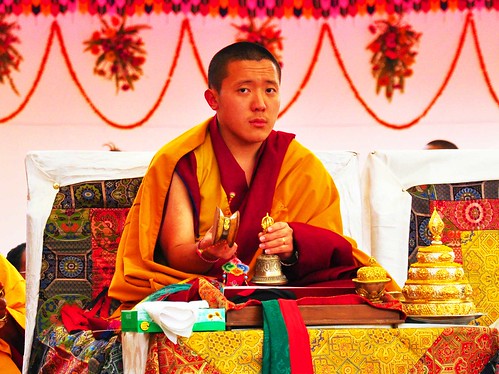
Khyenste Yangsi Rinpoche during the celebration

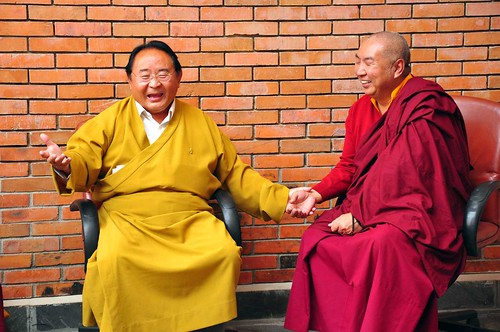
Sogyal Rinpoche and Khenpo Namdrol, host of the Rigpa Shedra East

This first post would be incomplete if I didn't write some words about the everyday life in the Shedra. Khenpo Sonam Tobden teaches on the Introduction to the Middle Way, Chandrakirti's treatise on Nagarjuna's Root Verses on the Middle Way. Even though I attend the class, I don't put much emphasis on home studies with regard to it. Instead I focus on Tibetan this year, and so I spend my time mainly working with different Tibetan texts and also going much more into the modern colloqiual Tibetan with the help of our lovely tutor Jigme-la as well as Khenpo himself. There is some process I would say... Altogether I spend less time in classes and more in my room, I enjoy it, hehe! Of course, self-discipline is required when doing things on your own! One of my favorite distractions from my regular studies, luckily a fruitful one, is my world of Dharma photography. If you are interested in the results, have a look at my new online photo website or at my facebook photos.

Class 2010

To conclude: the Buddhist teachings emphasize the fact that everything is linked to everything else, and that, by realizing this, our view of things and events as well as our actions with regard to others and ourselves, need to be permeated by gratitude and an attitude of love and compassion. So, in accordance with that, I would like to express my deepest appreciation to my precious teacher Sogyal Rinpoche and all those people who made and make it possible that I am here and able to do what I do. On this occasion I would like to thank especially those who support me financially. You know who you are. I feel very blessed! May all your help enable me to give back what I have learned and understood over the years to as many sentient beings as possible.

Sarva Mangalam!